
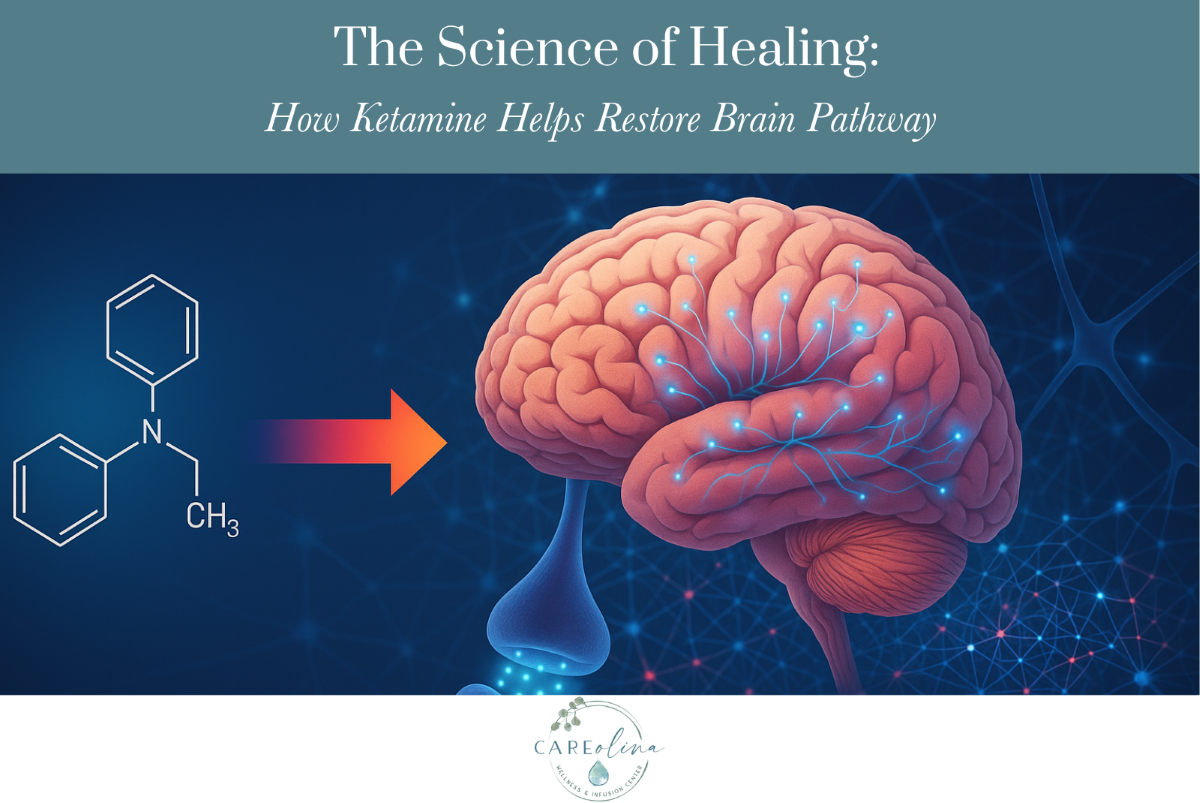
At CAREolina Wellness and Infusion Center, we take a science-first, patient-centered approach to mental health. One of the most exciting advances in the last decade is the discovery that ketamine can rapidly relieve symptoms of depression and help repair stressed brain circuits. Below, we break down how it works, who it may help, what to expect, and how we keep you safe.
Quick take: why ketamine is different
Most traditional antidepressants boost serotonin or norepinephrine and can take weeks to work. Ketamine acts on the brain’s glutamate system, setting off a cascade that can reconnect and strengthen synapses (the communication points between brain cells) in hours to days—a process sometimes described as “synaptic reboot.” National Institutes of Health (NIH)+1
How ketamine restores brain pathways (in plain English)
- It briefly blocks NMDA receptors
Ketamine is an NMDA-receptor antagonist. By temporarily dialing down this receptor’s activity on certain inhibitory (GABA) neurons, the brain responds with a healthy “glutamate burst.” MDPI - That glutamate burst boosts AMPA signaling
More glutamate means more AMPA receptor activity—the downstream signal researchers increasingly link to ketamine’s antidepressant effects and clearer thinking. PMC+1 - AMPA signaling flips on growth pathways
AMPA activation triggers BDNF (a growth factor) and the mTOR pathway, which together encourage new synapse formation and spine maturation—the cellular basis for more resilient circuits. PMC+1 - Networks reconnect; symptoms can lift
Animal and human imaging studies suggest ketamine can restore functional connectivity in mood-relevant regions (like the prefrontal cortex) and rebalance large-scale networks (e.g., the default mode network), aligning with rapid mood improvements. National Institute of Mental Health+2PMC+2
Bottom line: ketamine doesn’t just “numb” symptoms; it helps the brain re-wire toward healthier communication—often felt as relief from heaviness, rumination, and cognitive fog. Nature
Ketamine vs. esketamine (SPRAVATO®)
- Ketamine (racemic) is used off-label in many clinics via IV/IM routes under medical supervision.
- Esketamine (SPRAVATO®) is an FDA-approved nasal spray for adults with treatment-resistant depression and, as of January 2025, is also approved as monotherapy (used alone) in adults with TRD. It’s administered only in certified settings with observation. JNJ.com
Note: Off-label compounded ketamine and non-clinic use are not FDA-approved for psychiatric indications and carry safety risks; treatment should occur under trained medical supervision. Health
Who might benefit
Ketamine-based therapies are considered when depression has not responded to standard treatments, or when speed of relief matters. While response varies, many patients feel measurable improvement within 24–72 hours after initial dosing, with additional sessions consolidating gains. National Institutes of Health (NIH)
Safety, monitoring, and the CAREolina protocol
Common short-term effects include dissociation, blood pressure elevation, nausea, or fatigue, which typically resolve the same day. Because of these effects, treatments occur on site with vital-sign monitoring and a post-session observation period, and patients must arrange a safe ride home. (SPRAVATO® requires similar in-clinic monitoring per its risk-mitigation program.) FDA Access Data
We also emphasize integration—brief coaching and practical next steps after sessions—so neuroplasticity translates into sustainable life changes.
What to expect at CAREolina Wellness & Infusion Center
- Clinical consult & screening – We review your history, medications, medical conditions, and suitability.
- Personalized plan – Dosing schedule, and adjunct supports are tailored to your goals.
- Guided session day – A calm, supportive setting; continuous monitoring; optional mindfulness tools.
- Integration & follow-up – We track outcomes and adjust the plan to maintain gains.
Q&A: Your most common questions, answered
Q: How fast will I feel better?
A: Some people notice relief in hours to 1–3 days; others require several sessions. Early changes often include less rumination, improved motivation, and better sleep. National Institutes of Health (NIH)
Q: Is ketamine “just a band-aid”?
A: Evidence suggests ketamine helps rebuild synapses and restore network function, not merely mask symptoms—though maintenance strategies (booster sessions, therapy, sleep, activity, nutrition) are key to durability. PMC+1
Q: What’s happening inside my brain during/after a session?
A: Brief NMDA blockade → glutamate surge → AMPA activation → BDNF/mTOR → new/stronger synapses → better network communication linked to mood relief. MDPI+2PMC+2
Q: Is esketamine the same as IV ketamine?
A: They’re related but not identical. Esketamine is a specific enantiomer with FDA approval for treatment-resistant depression (including monotherapy as of 2025), delivered intranasally in a certified clinic. IV/IM ketamine is commonly used off-label with supportive evidence, but without formal FDA psychiatric approval. JNJ.com+1
Q: Will I hallucinate?
A: Many patients experience a dissociative or “dream-like” state during dosing, which fades as the medication wears off. We maintain a calm environment and monitor throughout. FDA Access Data
Q: Is it safe with my other medications?
A: We carefully review drug interactions and medical history (e.g., uncontrolled hypertension) during your consult to optimize safety.
Q: How long do results last?
A: Relief can last days to weeks after a single session; a series plus ongoing care can extend benefits. Individual response varies; we’ll tailor a maintenance plan to you. Nature
Q: Can ketamine help anxiety, PTSD, or pain?
A: Research is active and promising in several conditions, but approvals differ. We’ll discuss the evidence and options specific to your case. Nature
Why choose CAREolina
- Clinical rigor: Evidence-based protocols and real-time monitoring.
- Personalization: We integrate therapy-adjacent supports to turn neuroplasticity into lasting change.
- Comfort & care: A calming environment and compassionate team dedicated to you.
Ready to talk?
CAREolina Wellness and Infusion Center
1332 Westgate Center Drive
Winston-Salem, NC 27103
Phone: (336) 999-7116
Website: careolinawellness.com
Make an appointment: careolinawellness.janeapp.com
Medical information is educational and not a substitute for professional advice. We’ll help you decide if ketamine-based therapy is appropriate for you.